Wednesday, September 29, 2010

Personal philosophy?


When i was studying to be a early childhood teacher i had already been working in and surrounded by the industry for some time. Because of this i already had some ideas on how i felt about it all, most of which i thought were the 'right' ones to have at the time, however when ever i went on practicum or was faced with the question of 'what is my personal philosophy?' i froze up. thinking about it now when i have the time to reflect it was posibly because this questin seems so daunting...MY PERSONAL PHILOSOPHY, it sounds so final. what if i got it wrong, and if i go too P.C then its not really mine, i don't think I'm really a P.C kind of teacher ( not saying i run around being racist or sexist or any of the other 'ists' that come to mind when P.C comes up) I'm talking about the fact that sometimes the world is hard and i do not think that sheltering our children by covering them in bubble wrap is going to prepare them for what happens in the real world. Even the school playground is a dangerous place, all the mixes of personalities there is bound to be a few clashes. Children should not have to like every one in their class, as an adult we are not expected to like every one we meet so why should they (not giving permission to be mean just thinking that no one has to be buddies if they don't want to). Also sharing......if one child had it then they had it, making them share with someone is just teaching the other child if you kick up enough fuss then you get what you want with out waiting. what about teaching children the idea of waiting for what they want, half the time i have discovered it is more about the fuss than the want of the actual item. sharing has a time and a place, group activities where children are aware that sharing is going to come up, rather than someone interrupting their solitary play. My true issue is how can all of this be said without coming across as a rude ignorant and uninformed? i have done the study i have observed interactions and i have come away with these things.......MY ROLE AS A TEACHER THE WAY I SEE IT:

I AM THERE TO SUPPORT EACH INDIVIDUAL IN THIER GROTH AND DEVELOPMENT, I AM THERE TO PROVIDE ALL THE INFORMATION THEY COULD WANT AND MORE TO GUIDE THEM THROUGH THEIR YOUNG YEARS IN LIFE. I AM THERE AS A ROLE MODEL. I AM THERE TO ENSURE THE WHOLE CHILD IS CATERED TO. I WILL BE THERE AS A SCAFFOLD OF INFORMATION, LOVE AND INTEREST IN THEIR LIFE AS I AM PART OF IT. I AM THEIR TO PROVIDE EVERY OPPORTUNITY FOR LEARNING, INTEREST, EXPLORATION AND DISCOVERY. I AM THERE TO BE OPEN TO THEIR IDEAS AND THEIR NEEDS. THEIR FAMILY IS THE MOST IMPORTANT THING IN EACH CHILD'S LIFE, I AM AWARE OF THIS AND AM THERE TO SUPPORT THEM IN THEIR JOURNEY TO GROWING GREAT ADULTS.

research

Get Ready for Back to School with NAEYC!
Ten Tips for Involving Families through Online Communication
It is crucial for families to be involved in their child's early education. While there are many traditional forms of home-school partnerships, this list from NAEYC's Spotlight on Teaching Preschoolers 2 book will help you improve communication with your families.
1. Create a classroom website. 2. Send individual emails to families to share positive information about their child's activities and accomplishments. 3. Post photo stories on the class website. 4. Provide at-home educational activities. 5. Create a family response link or form on the website to elicit comments, questions, and feedback. 6. Establish and moderate a family support discussion forum. 7. Communicate logistical information through group emails. 8. Ensure families' access to technology. 9. Provide opportunities for families to increase their technology skills. 10. Set aside time for technology-based communication.

Monday, September 27, 2010

learning activities, programmes and assessment.

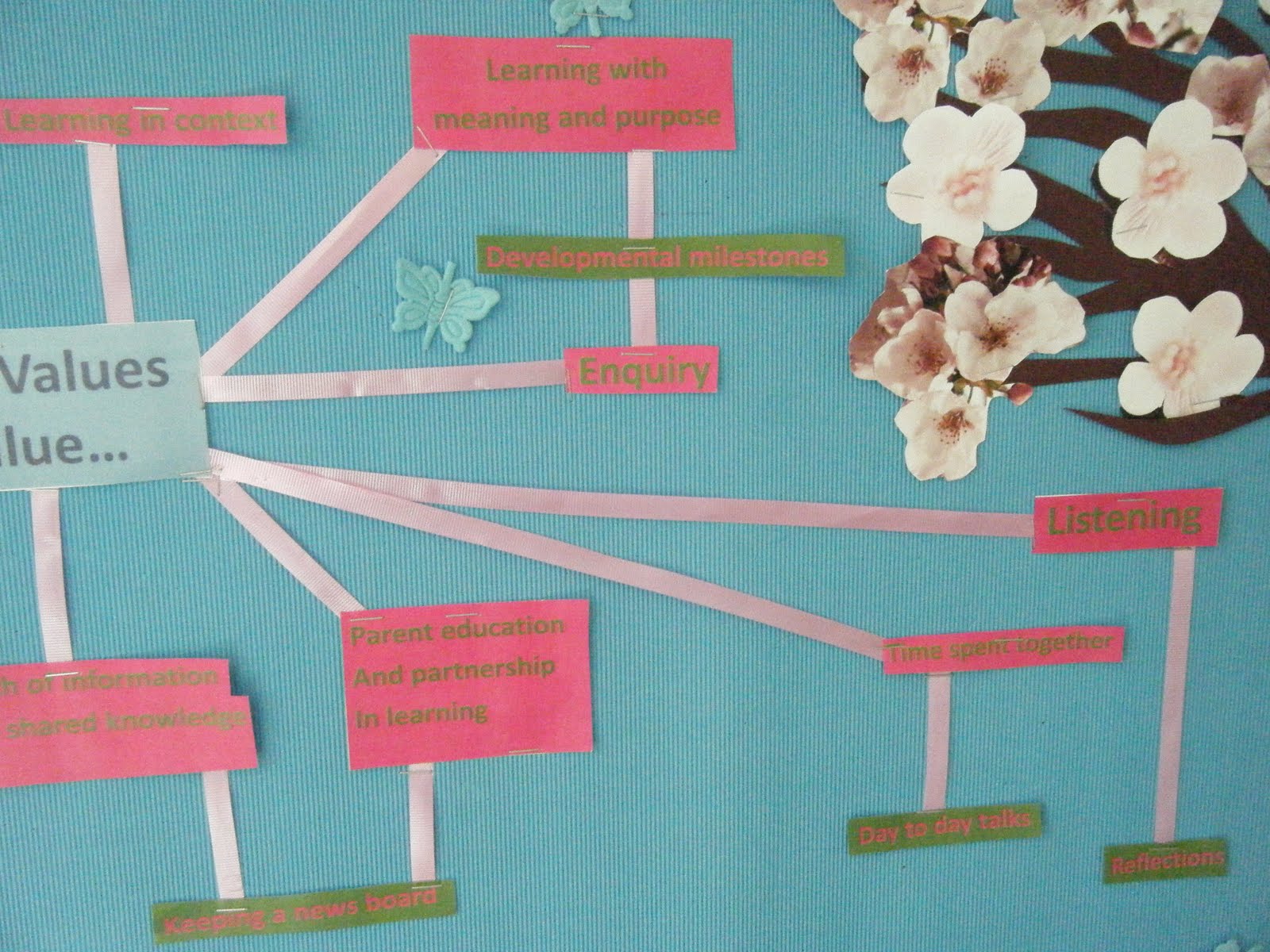
My planning wall: linking our values of our centre to activities and experiences. also bringing in family and whanau, the importance of learning and sharing together.


Current Theory/ ideas

Meeting and greeting key part of the day at childcare
By Elizabeth Binning 4:00 AM Saturday Apr 17, 2010 Share


Rod EmmersonThe first 30 seconds when a child is left at daycare are the most important in making them feel emotionally secure for the rest of the day.

That's the finding from visiting Australian child psychologist Dr Robyn Dolby, who says those first few moments can make a huge difference in the child's emotional wellbeing and in teaching them to understand and organise their feelings.

"In the first 30 seconds of coming into daycare children are looking for someone to connect with. They are asking, 'Am I on your radar, do you see me?'

"Our research has shown that greeting parents and children in a way that focuses on how the child actually feels and including the parent in that conversation makes both of them feel more relaxed and included," she said.

Dr Dolby is in New Zealand this week for a one-day conference for childcare professionals, caregivers, social workers, nurses and other professionals who work with children and families.

Speaking to the Weekend Herald, she said research had revealed that when children arrived at preschool with their mum and dad, they look around for someone to connect with.

Failure to find that connection straightaway meant the child might take longer to feel they had a place in the daycare. Taking longer to settle in meant it could take longer for them to learn.

The research comes from a 10-year project called Attachment Matters - From Relationships to Learning at Preschool.

Part of that project involves creating "play spaces" where staff sit down in a place in the playground conducting an activity and don't move from there for the first hour of the day.

Dr Dolby said an example might be a teacher always being in the sandpit each morning so when children arrived they could seek out their favourite carer and go straight to them. It also created an opportunity for parents, carers and children to interact.

The philosophy has recently been taken up by a playcentre run by the Anglican Trust for Women and Children in Auckland, which is hosting Dr Dolby this week.

Trust clinical director Michelle Ball said the model was working well, with significant changes noticed by both staff and parents.

Children seemed more settled and happier.

By Elizabeth Binning | Email Elizabeth

Teaching and Learning


Conference 2010, this was my fist conference where i was helping to present, it was an opportunity or me to teach others what happens in my centre and share ideas on a national level. it was also a great learning curve for me as a teacher, usually i am surrounded by infant and toddlers when i teach not teacher that have trained and worked in the educaton sector for years (many more than myself). It was a great experience and i have now gone further from it, presenting our ideas and practices of ICT IN ECE to several different groups, training groups and other conferences. i look forward to extending my knowledge through interactions with other teachers.

Thursday, August 5, 2010

Working Mums OK

August 3, 2010, 4:47 pm
Working Moms Are Fine for Kids
By LISA BELKIN
Eight years ago, researchers at Columbia University worried a lot of new parents when they concluded that children whose mothers left home for full-time work in the first year of life were cognitively delayed compared with one-year-olds whose mothers stayed home. (No, the study did not measure the effect of working fathers.)

That well-publicized finding probably led some women to stay home. But given that more than 60 percent of mothers work when their children are younger than 6, the more likely result of the research was to increase the guilt and stress of working moms.

Now those same researchers are telling mothers to relax. Their latest research — which appears this month in Monographs of the Society for Research in Child Development, follows the children to first grade. Titled “First-Year Maternal Employment and Child Development in the First 7 Years”, it confirms what the authors call a “mild” cognitive lag among children whose mothers worked during the first year. But it then goes on to conclude that other factors (benefits of having a working mother, if you will) offset that harm, meaning “the overall effect of first-year maternal employment on child development is neutral.”

In 113 pages, Jeanne Brooks-Gunn, Wen-Jui Han, and Jane Waldfogel of the Teachers College and College of Physicians and Surgeons at Columbia, analyze data gathered from 1,000 children across the U.S., as part of the National Institute of Child Health and Human Development Study of Early Child Care. It found that working mothers displayed greater “maternal sensitivity,” or responsiveness, toward their youngsters, had a higher income and were more likely to find higher quality child care. In the end, the effect on a child’s intellectual, physical and emotional development was a wash.

Because of this, Jeanne Brooks-Gunn, lead author of the study, told The Washington Post that “this particular research has a positive message for mothers that the earlier research didn’t.”

Will that make the return to the work force easier for new mothers? Lillian Dunn wrote to Motherlode recently, asking why mothers are so hard on each other and give such scathing public advice. I heard from her again this week, just as this study came across my desk. She is about to go back to work at the New York City Department of Health, and she is struggling with the re-entry. She has another question. I told her I would pass it along.

She writes:

Tonight, I’m thinking about the end of my maternity leave. I have chosen to return to work and — much to my surprise — am rather sad about it. I grew up with a working mom and naturally assumed that would be the path I would prefer. But now, seeing my days fill up with meetings and program indicators rather than diapers and baby toys, I’m wondering if I haven’t chose poorly.

I’m trying to compose a letter to my daughter to tell her why I’m to go back to work, why I won’t be staying at home with her. I’m thinking about what her career choices will be, and praying that by the time she’s my age, raising her own family, that she will actually have a choice and — God willing — even some adequate paid maternity leave. I’m wondering what Alice will do when she is in my shoes.

For all those Motherlode readers out there: What would they tell their daughters or their sons the night before maternity leave ends?